Questions and answers
HLRCC FAQ
Most frequent questions and answers
Information on this site is educational and is not a substitute for advice from your own physician.
About HLRCC
3 questions
Three main parts of the body HLRCC can affect
Skin, uterus and kidneys
- Skin
Skin leiomyomas
Small firm bumps. They can hurt, or feel sore in the cold or when touched. They are not cancer.[2]
How common is HLRCC?
There are variable estimates of the prevalence of HLRCC, but genetic testing suggests that the condition is much more common than previously thought. Newer research suggests about 1 in 1,000 people may carry a harmful change in the FH gene. [9] In a study of more than 120,000 people who had genetic testing for inherited cancer risk, about 1 in 2,668 people who had no clear sign of HLRCC were found to have a harmful FH change. [10] Not everyone who carries the change develops signs of HLRCC[1].
Why is HLRCC called a syndrome and how does it affect individuals with the condition?
HLRCC, also known as hereditary leiomyomatosis and renal cell carcinoma syndrome, is called a syndrome because it involves a cluster of symptoms and manifestations that may occur together. HLRCC is caused by a mutation in the FH gene, which leads to the development of benign tumors called leiomyomas in the skin and uterus, as well as a higher risk of developing kidney cancer. The severity of symptoms and the risk of cancer can vary widely among individuals with HLRCC, even within the same family. [1, 2]
What is fumarate hydratase (FH) and how does a mutation in this gene cause HLRCC?
A fumarate hydratase (FH) mutation is a genetic alteration that affects the function of the FH protein. FH is an enzyme that plays a critical role in the Krebs cycle, which is responsible for generating energy in cells. When FH is mutated, it can lead to a buildup of fumarate, a metabolite that is normally broken down by the FH enzyme. This buildup of fumarate is thought to be responsible for the development of tumors in individuals with hereditary leiomyomatosis and renal cell carcinoma (HLRCC) syndrome. [1, 2]
The exact mechanism by which FH mutations lead to the development of tumors is not fully understood, but it is thought to be related to the disruption of cellular metabolism and changes in how cells sense oxygen. [1, 50] A tumor can start when the second copy of the FH gene in a cell also changes, which can happen by chance or from environmental factors such as sun exposure. [35, 50]
Genetics and testing
3 questions
How HLRCC is passed on
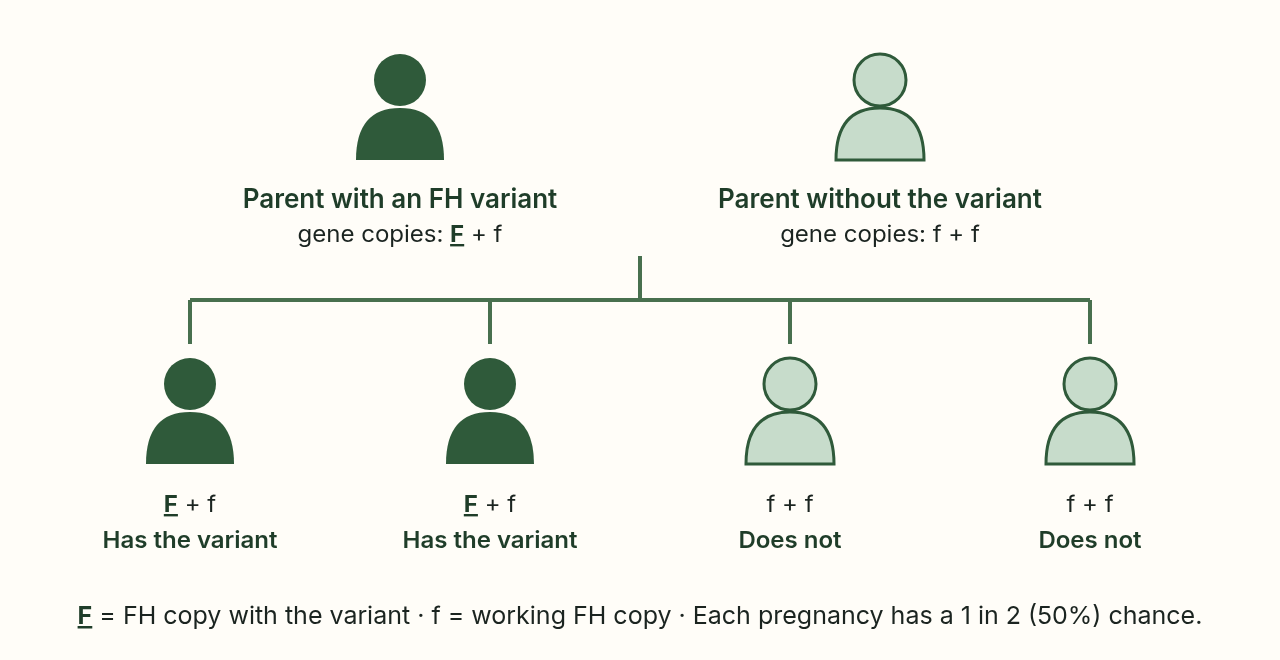
Can HLRCC be passed on to other family members?
Yes, HLRCC can be passed on to other family members. HLRCC is an autosomal dominant genetic disorder, which means that an individual with a mutation in the FH gene has a 50% chance of passing the mutation on to each of their children. [1, 2]
Genetic testing can be used to identify individuals who carry the FH mutation and who may be at increased risk of developing HLRCC-related tumors. If a family member is found to carry the mutation, they can work with their healthcare provider to develop a personalized plan for monitoring and managing their health. Regular screening for kidney tumors is recommended for individuals with HLRCC so that tumors can be found early and removed while they are small. Studies have not yet proven that this helps people live longer, but it is what experts recommend. [1, 2, 5]
Who should be tested for HLRCC?
NCI says FH gene testing is advised for anyone who has HLRCC or may have it, whatever their family history. [2]
Talk with your doctor about genetic counseling if you have:
- one or more skin leiomyomas confirmed by a biopsy[2]
- a kidney cancer that looks like the HLRCC type (FH-deficient) under the microscope[1, 2]
- fibroids that test FH-deficient in the lab, or fibroids needing surgery before age 40, especially with a family history of HLRCC signs[1, 2, 15, 45]
- a blood relative with a known harmful FH change[1, 2]
A genetic counselor can help you decide whether testing is right for you. [2]
How does knowing I have HLRCC help me?
Knowing that you have HLRCC is beneficial because it enables appropriate surveillance with abdominal MRI for early detection of kidney cancers that can be surgically removed with curative intent. [1, 3, 5] If the cancer has spread, some drug treatments have shrunk this type of kidney cancer in many people in studies. For example, in one NIH study of 43 people, bevacizumab plus erlotinib shrank the cancer in 31 (72%)[12]. Additionally, it allows for appropriate counseling of family members to undergo kidney cancer surveillance if they also have the condition. [1]
What an FH genetic test result means
A genetic test on a blood or saliva sample looks for a change in the FH gene.[60]
- Positive
A harmful change was found
The report may call it pathogenic or likely pathogenic. In most cases this confirms HLRCC (also called FH tumor predisposition syndrome). A few specific FH changes carry different risks, so ask your genetics team what your exact change means. Experts recommend a kidney MRI every year, regular skin checks, and gynecology care if you have a uterus.[1, 2]
- Variant of uncertain significance (VUS)
A change was found, but its meaning is not yet known
A VUS does not confirm or rule out HLRCC.[1, 39] Doctors follow your own and your family's health history instead. A VUS can be updated later, so ask your genetic counselor to check again from time to time.[39, 40]
Kidney
2 questions
Your check-up timeline
Use this with your care team. Your own plan may be different.
- After diagnosisMeet a genetic counselor. Tell close relatives.[1, 2]
- From age 8, a yearly kidney MRI, for life. Your urologic oncologist or medical oncologist will decide the exact timing.[1, 3, 5] Ask for a kidney MRI with 1 to 3 mm slices through the kidneys. If a spot needs watching, the same type of scan is used each time so results can be compared.[1, 2, 5]
- If you have a uterusA gynecology visit. NCI advises one every year; GeneReviews advises one when symptoms or family planning call for it. Ultrasound or MRI if advised.[1, 2]
- Every 1 to 2 yearsSkin check: a full skin exam by a dermatologist. NCI notes there is no agreed schedule for skin exams.[1, 2]
A typical six years
How often should individuals screen for kidney cancer and at what age?
Abdominal MRI surveillance for HLRCC should begin at age 8 and continue throughout the individual’s life; your urologic oncologist or medical oncologist will decide the exact timing. [1, 3, 5] If a scan shows a possible tumor, it needs prompt follow-up by a team that knows HLRCC. If it is a tumor, experts advise prompt surgery, even if it is small, rather than waiting. [1, 2, 3, 5]
What treatments are available for metastatic FH-deficient RCC?
There are several treatment options available for HLRCC, including EGFR inhibition with Erlotinib combined with Bevacizumab, a VEGF inhibitor. In an NIH study of 43 people with HLRCC-related kidney cancer, this combination shrank the cancer in 31 of them (72%); the study did not compare it with other treatments. [12] Additionally, tyrosine kinase inhibitors and immunotherapy can also be used. Clinical trials may also be an option to improve outcomes. It is important to discuss all available treatment options with an oncologist familiar with HLRCC to determine the best course of action for each individual case. [1, 3, 23]
Summary: kidney cancer risk, surveillance and treatment
HLRCC is caused by a mutation in the FH gene. It leads to benign tumors called leiomyomas in the skin and uterus and a higher risk of kidney cancer. [1, 5] From age 8, experts recommend a yearly kidney MRI for life. Your urologic oncologist or medical oncologist will decide the exact timing. [1, 3, 5] If a kidney tumor is found, experts advise prompt surgery, even if it is small, rather than waiting. [1, 5]
Skin
1 question
How are skin leiomyomas managed?
When piloleiomyomas (skin leiomyomas) occur as a result of HLRCC, they tend to appear earlier in life, with the average onset age of 25 years (ranging from 10 to 47 years old)[2]. Piloleiomyomas typically manifest as a singular dermal nodule or multiple dermal nodules arranged in a clustered, segmental (limited to one area of the body), or widespread pattern. [1, 2]
Skin leiomyomas can be hard to treat, and medicines help some people's pain but not everyone's. [2, 14] The treatment approach depends on the number and location of lesions and the degree of discomfort experienced by the patient. Bumps that cause no problems usually need no treatment. [2, 20] Surgery to remove the bump is a standard treatment when there are one or a few painful bumps, but bumps often come back. [1] Other treatment options include cryosurgery and carbon dioxide (CO2) laser ablation. [1, 2, 14]
Uterine fibroids
1 question
How are uterine leiomyomas (fibroids) managed?
With appropriate management by an experienced OB/GYN physician, uterine fibroids in women with HLRCC can often be monitored closely and managed on an as needed basis. Compared to non-hereditary uterine leiomyomas, those associated with HLRCC tend to be larger, more numerous, develop at a younger age, and are more likely to require surgical removal or hysterectomy. [1, 2, 32]
Living with HLRCC
2 questions
Why is it important to seek guidance from physicians familiar with HLRCC?
What are the benefits of being evaluated and treated at the NIH for this condition?
The Urologic Oncology Branch of the National Cancer Institute at NIH, headed by Dr. W. Marston Linehan, is interested in evaluating/managing patients affected with, or at risk for, Hereditary Leiomyomatosis and Renal Cell Cancer (HLRCC). The NIH has a long-term interest in the disorder and runs a long-term study of HLRCC (NIH protocol 03-C-0066; ClinicalTrials.gov NCT00050752). [17, 52]
Those affected with advanced disease would be evaluated by the NIH’s therapeutic team, led by Ramaprasad Srinivasan, M.D., Ph.D. The NIH also runs a treatment trial for advanced HLRCC-related kidney cancer (NCT04981509). Enrollment can change at each site, so check the ClinicalTrials.gov listing for current status. [23, 52]
To ask about the NIH HLRCC study (NCT00050752), the contact listed on ClinicalTrials.gov is Deborah A. Nielsen, R.N., (240) 760-6247, deborah.nielsen@nih.gov. [17]
About the Foundation
We encourage you to look through our website and the Handbook.
We also encourage you to reach out to us and ask for support – or offer it to another member.
We are a small, active community. You can also find us on Facebook and X (formerly Twitter).
Download the Quick Facts brochure for a quick overview and then study our Handbook for more detailed information about the condition.
References
Sources (20)
- Kamihara J, Schultz KA, Rana HQ. FH tumor predisposition syndrome. 2006 Jul 31 [updated 2025 May 8]. In: Adam MP, et al., eds. GeneReviews®. Seattle (WA): University of Washington; 1993–2026. PMID 20301430. www.ncbi.nlm.nih.gov↑ 1 2 3 4 5 6 7 8 9 10 11 12 13 14 15 16 17 18 19 20 21 22 23 24 25 26 27 28 29 30 31 32 33 34 35 36
- PDQ Cancer Genetics Editorial Board. Hereditary leiomyomatosis and renal cell cancer (PDQ®), health professional version. NCI; updated 2024 Nov 6. PMID 33724749. www.cancer.gov↑ 1 2 3 4 5 6 7 8 9 10 11 12 13 14 15 16 17 18 19 20 21 22 23 24 25 26 27 28 29 30
- NCCN Guidelines for Patients®: Kidney Cancer, 2026 (based on NCCN Guidelines® Kidney Cancer v1.2026, 2025 Jul 24), pp. 55–57 (Guides 8–10). www.nccn.org↑ a b c d e f g h
- Menko FH, Maher ER, Schmidt LS, et al. Hereditary leiomyomatosis and renal cell cancer (HLRCC): renal cancer risk, surveillance and treatment. Fam Cancer. 2014;13(4):637-44. doi:10.1007/s10689-014-9735-2. PMID 25012257; PMC4574691. pubmed.ncbi.nlm.nih.gov↑ a b c d e f g h i j
- Shuch B, Li S, Risch H, et al. Estimation of the carrier frequency of fumarate hydratase alterations and implications for kidney cancer risk in hereditary leiomyomatosis and renal cancer. Cancer. 2020;126(16):3657-66. doi:10.1002/cncr.32914. PMID 32413184; PMC10316675. pubmed.ncbi.nlm.nih.gov↑
- Lu E, Hatchell KE, Nielsen SM, et al. Fumarate hydratase variant prevalence and manifestations among individuals receiving germline testing. Cancer. 2022;128(4):675-84. doi:10.1002/cncr.33997. PMID 34724198. pubmed.ncbi.nlm.nih.gov↑
- Srinivasan R, Gurram S, Singer EA, et al. Bevacizumab and erlotinib in hereditary and sporadic papillary kidney cancer. N Engl J Med. 2025;392(23):2346-56. doi:10.1056/NEJMoa2200900. PMID 40532152. pubmed.ncbi.nlm.nih.gov↑ a b
- Naik HB, Steinberg SM, Middelton LA, et al. Efficacy of intralesional botulinum toxin A for treatment of painful cutaneous leiomyomas: a randomized clinical trial. JAMA Dermatol. 2015;151(10):1096-102. doi:10.1001/jamadermatol.2015.1793. PMID 26244563; PMC7712636. pubmed.ncbi.nlm.nih.gov↑ a b
- Kipnis LM, Breen KM, Koeller DR, et al. Germline and somatic fumarate hydratase testing in atypical uterine leiomyomata. Cancer Prev Res (Phila). 2024;17(5):201-8. doi:10.1158/1940-6207.CAPR-23-0535. PMID 38638033. pubmed.ncbi.nlm.nih.gov↑
- ClinicalTrials.gov NCT00050752 (NCI; NIH protocol 03-C-0066). Accessed 2026 Oct 30. clinicaltrials.gov↑ a b
- Michaeli O, Kim SY, Mitchell SG, et al. Update on Cancer Screening in Children with Syndromes of Bone Lesions, Hereditary Leiomyomatosis and Renal Cell Carcinoma Syndrome, and Other Rare Syndromes. Clin Cancer Res. 2025;31(3):457-65. doi:10.1158/1078-0432.CCR-24-2171. PMID 39601780; PMC11790369. pubmed.ncbi.nlm.nih.gov↑
- ClinicalTrials.gov NCT04981509, NCT07716735 and NCT04623502. Accessed 2026 Oct 30. clinicaltrials.gov↑ a b
- Hessi R, Bendayan E, Mija LA, et al. Uterine leiomyomas in HLRCC: a scoping review of presentation, histopathology, treatment patterns, and reproductive implications. Eur J Hum Genet. 2026 Oct 16 [Epub ahead of print]. doi:10.1038/s41431-026-02255-y. PMID 42888221. pubmed.ncbi.nlm.nih.gov↑
- MedlinePlus Genetics. Hereditary leiomyomatosis and renal cell cancer. (last updated 2018 Feb 1; accessed 2026-10) medlineplus.gov↑
- Richards S, Aziz N, Bale S, et al. Standards and guidelines for the interpretation of sequence variants: a joint consensus recommendation of the American College of Medical Genetics and Genomics and the Association for Molecular Pathology. Genet Med. 2015;17(5):405-24. doi:10.1038/gim.2015.30. PMID 25741868; PMC4544753. pubmed.ncbi.nlm.nih.gov↑ a b
- Deignan JL, Chung WK, Kearney HM, et al. Points to consider in the reevaluation and reanalysis of genomic test results: a statement of the American College of Medical Genetics and Genomics (ACMG). Genet Med. 2019;21(6):1267-70. doi:10.1038/s41436-019-0478-1. PMID 31015575. pubmed.ncbi.nlm.nih.gov↑
- VKGN / Stichting Opsporing Erfelijke Tumoren. Hereditaire leiomyomatosis en niercelcarcinoom (HLRCC), guideline version 8, last changed 2026-01-16. vkgn.stoet.nl↑
- MedlinePlus Genetics. FH gene. (last updated 2017 Sep 1; accessed 2026-10) medlineplus.gov↑ a b
- NCI Center for Cancer Research. Urologic Oncology Branch and Support Services. ccr.cancer.gov/urologic-oncology-branch ccr.cancer.gov/urologic-oncology-branch/clinical-team/support-services↑ a b
- National Cancer Institute. Genetic Testing for Inherited Cancer Risk (Genetic Testing Fact Sheet). Reviewed 2024 Apr 18. www.cancer.gov↑ a b