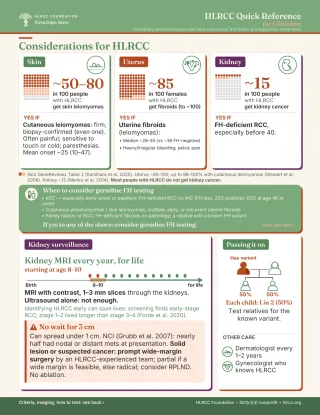
Hereditary Leiomyomatosis and Renal Cell Cancer
HLRCC Foundation · Guide for Patients and Families
HLRCC Handbook
Living with HLRCC: a plain-language guide for patients and families.
Educational, not medical advice. Talk with your care team about your own plan.
On this page
What is HLRCC?
HLRCC is short for hereditary leiomyomatosis and renal cell cancer, and HLRCC is the preferred name. It is sometimes referred to as FH tumor predisposition syndrome. [1]
Older names you may still see include Reed syndrome and multiple cutaneous and uterine leiomyomatosis (MCUL). [1, 2]
- Hereditary means it runs in families.
- Leiomyomatosis means growths made of smooth muscle. They are not cancer.
- Renal cell cancer means kidney cancer.
HLRCC is caused by a change in a gene called FH. Genes are like instructions for your body. Everyone has two copies of the FH gene. People with HLRCC have one copy that does not work well. [1, 2]
About 1 in 1,000 people may carry a harmful change in the FH gene (Shuch 2020). [9] In a study of more than 120,000 people who had genetic testing for inherited cancer risk, about 1 in 2,668 of those with no known signs of HLRCC had an HLRCC-related FH change. [10]
The most important thing to know: having HLRCC does not mean you have cancer or that you will get it. It means your risk of kidney cancer is higher than usual. Checking your kidneys every year helps doctors find a problem early. [1, 2]
Three main parts of the body HLRCC can affect
Skin, uterus and kidneys
- Skin
Skin leiomyomas
Small firm bumps. They can hurt, or feel sore in the cold or when touched. They are not cancer. [2]
What can HLRCC cause?
HLRCC is different for everyone, even in the same family. A person may have one, two, all three or none of these: [2]
| Body part | What can happen | Is it cancer? |
|---|---|---|
| Skin | Small firm bumps called leiomyomas. They can hurt, or feel sore in the cold or when touched. [2] | No |
| Uterus (womb) | Fibroids. In HLRCC they are often larger, more numerous and appear at a younger age, around 30 on average. [1, 2] | No |
| Kidneys | A higher chance of a kind of kidney cancer that can spread even when it is small. [1, 2] | Yes, when it happens |
Estimates vary widely. NCI’s expert summary says most estimates are 15 to 30 in 100 over a lifetime [2]; a 2020 study using large population databases suggests the risk may be much lower [9]. Most people with HLRCC do not get kidney cancer.
How HLRCC is passed on
A parent with HLRCC has a 1 in 2 (50%) chance of passing the FH change to each child. Boys and girls have the same chance. [1, 2] Very rarely, a child inherits an FH change from both parents. This causes a serious metabolic condition called fumarate hydratase deficiency (also called fumarase deficiency), which starts in newborns and young babies. [1, 2]
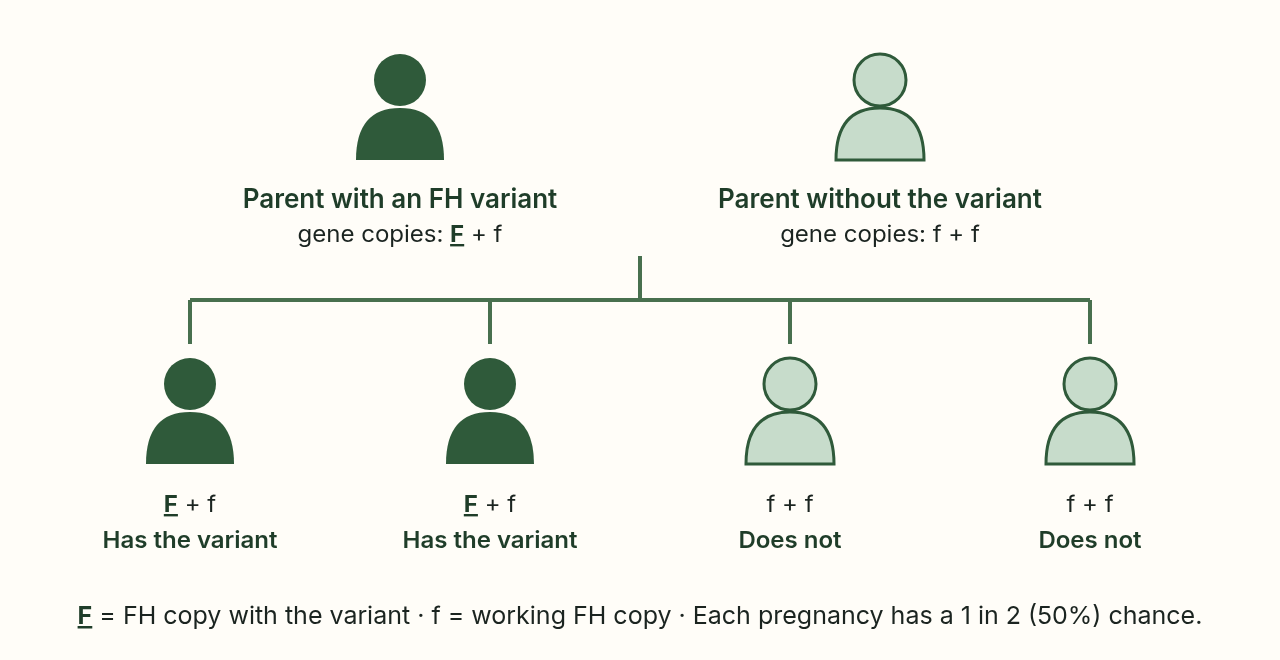
- If you did not get the family's FH change, you cannot pass it on to your children. [1, 2]
- Sometimes a parent has the change but never has any signs, so it can look as if it "skipped" a generation. [1]
- No test can tell which signs a child with the change will have, or when. [1]
How do I know if I have it?
A genetic test on a blood or saliva sample looks for a change in the FH gene. [1, 3]
- In most cases, if the test finds a harmful change in the FH gene, it confirms HLRCC. A few FH changes carry different risks, so your genetic counselor will explain what your result means. The report may call it "pathogenic" or "likely pathogenic." [1, 2]
- A result called a variant of uncertain significance (VUS) is possible. A VUS does not confirm or rule out HLRCC. [1, 39] Doctors follow your own and your family's health history instead. [39] Relatives are not offered predictive testing for a VUS, although a laboratory may ask some relatives to be tested to help clarify it. [36, 39] A VUS can be updated later, so ask your genetic counselor to check again from time to time. [40] Once one person in a family has a known change, relatives can take a simpler test that looks only for that change. [1, 2]
A genetic counselor can help you decide about testing and explain what results mean. [43] You can find one through the National Society of Genetic Counselors. [19]
What an FH genetic test result means
A genetic test on a blood or saliva sample looks for a change in the FH gene. [43]
- Positive
A harmful change was found
The report may call it pathogenic or likely pathogenic. In most cases this confirms HLRCC (also called FH tumor predisposition syndrome). A few specific FH changes carry different risks, so ask your genetics team what your exact change means. Experts recommend a kidney MRI every year, regular skin checks, and gynecology care if you have a uterus. [1, 2]
- Variant of uncertain significance (VUS)
A change was found, but its meaning is not yet known
A VUS does not confirm or rule out HLRCC. [1, 39] Doctors follow your own and your family's health history instead. A VUS can be updated later, so ask your genetic counselor to check again from time to time. [39, 40]
What to expect
Your skin
Skin leiomyomas are firm bumps. They can be skin-colored, pink, light brown or reddish-brown. They are most often on the chest, back, arms and legs. They usually first appear between the teen years and the forties, and more can appear over time. [1, 2]
- A doctor needs to take a tiny sample (a biopsy) to be sure a bump is a leiomyoma. [1]
- Bumps that cause no problems usually need no treatment. [2, 20]
- Painful bumps can be removed or treated with laser or freezing, and some medicines can ease the pain. [1, 2]
- See a skin doctor (dermatologist) every 1 to 2 years for a full skin check. [1] NCI notes there is no agreed schedule for skin exams. [2]
Fibroids (for women)
Fibroids are growths in the wall of the uterus. They are not cancer. Most women with HLRCC-related fibroids have heavy or irregular periods, and many have pelvic pain. [1, 2, 32]
- See a gynecologist who knows about HLRCC. NCI’s summary suggests a yearly visit with scans from time to time [2]; GeneReviews suggests visits as needed for symptoms and family planning [1]. Ask your gynecologist how often is right for you.
- Ways to treat fibroids: medicine; a hormone IUD placed in the uterus; surgery to take out only the fibroids (myomectomy); surgery to take out the uterus (hysterectomy). [1, 2]
- If you hope to have children, talk with your gynecologist early about timing. [1] NCCN's patient guideline also suggests considering kidney imaging before a planned pregnancy. [3]
- After any fibroid surgery, the tissue should be checked by a lab. [1]
Your kidneys
The kidney cancer linked to HLRCC is called FH-deficient renal cell carcinoma. It can grow and spread even when it is small. It often causes no symptoms at first. [1, 2, 11]
- From age 8, a yearly kidney MRI, for life. Your urologic oncologist or medical oncologist will decide the exact timing. [1, 2]
- An ultrasound alone is never enough to check the kidneys in HLRCC. [2]
- If a scan finds a tumor, it should be removed by surgery soon, even if it is small. Do not wait for it to reach 3 cm (about 1 inch). That rule is used for some other conditions, but not for HLRCC. [1, 2, 3, 5]
- Choose a kidney surgeon (urologic oncologist) who has experience with HLRCC. [1]
- Tell your doctor if you see blood in your urine, have pain in your lower back, or feel a lump in your belly. [1, 2]
Rare: adrenal and nerve-tissue tumors
A few specific FH changes are linked to tumors called pheochromocytoma or paraganglioma. [1, 20] These can cause high blood pressure, headaches, a racing heart and sweating. [44] If your family has one of these changes, your doctor may add yearly blood or urine tests and a scan every two years. [1, 2, 16, 20] Most people with HLRCC do not need these extra tests. [2]
Your check-up calendar
Use this calendar with your care team. Your own plan may be different.
Your check-up timeline
Use this with your care team. Your own plan may be different.
- After diagnosisMeet a genetic counselor. Tell close relatives. [1, 2]
- From age 8, a yearly kidney MRI, for life. Your urologic oncologist or medical oncologist will decide the exact timing. [1, 3, 5] Ask for a kidney MRI with 1 to 3 mm slices through the kidneys. If a spot needs watching, the same type of scan is used each time so results can be compared. [1, 2, 5]
- If you have a uterusA gynecology visit. NCI advises one every year; GeneReviews advises one when symptoms or family planning call for it. Ultrasound or MRI if advised. [1, 2]
- Every 1 to 2 yearsSkin check: a full skin exam by a dermatologist. NCI notes there is no agreed schedule for skin exams. [1, 2]
A typical six years
| When | What | Who | Done? |
|---|---|---|---|
| Every year | A kidney MRI with 1 to 3 mm slices through the kidneys. [1, 5] Your radiology team will decide whether contrast dye is needed. [20] If a spot needs watching, ask for the same type of scan each time. [2] CT if MRI is not possible. [3] From age 8, a yearly kidney MRI, for life. Your urologic oncologist or medical oncologist will decide the exact timing. [1, 2] | Radiologist; HLRCC doctor reviews results | |
| Often yearly [2] (if you have a uterus); ask your gynecologist [1] | Gynecology visit; ultrasound or MRI if advised. [1, 2] | Gynecologist | |
| Every 1–2 years | Full skin check. [1] NCI notes there is no agreed schedule for skin exams. [2] | Dermatologist | |
| Only for certain FH changes | Check blood pressure at every visit. Have a blood or urine test each year. From age 10, have a body MRI every 2 years. [1, 20] | Your HLRCC doctor | |
| After diagnosis, and before planning a family | Genetic counseling; tell close relatives. [1, 2] | Genetic counselor |
My scan record
| Year | Scan type and date | Result | Next scan due |
|---|---|---|---|
Tips for your MRI
- If a spot is being watched, ask for the same kind of scan each time, so results can be compared. [2]
- If small spaces worry you, tell the team before your visit. Ask if you can go in feet first.
- Bring a copy of your past scan reports, or ask that they be sent ahead.
Questions to ask your doctor
About my diagnosis
- What is my exact FH change? Can I have a copy of my genetic test report?
- Do I need to see a genetic counselor?
- Is my FH change one of the few linked to pheochromocytoma or paraganglioma?
About my kidney scans
- When is my next kidney MRI? Who will read it?
- Does the radiologist know about HLRCC?
- Will you use the same kind of scan each year?
- What happens if the scan finds a cyst or a spot?
If a kidney tumor is found
- Is the surgeon experienced with HLRCC?
- Will the tumor be removed soon, with a wide margin?
- Is a clinical trial right for me?
About fibroids and skin
- How often should I see a gynecologist and a dermatologist?
- What are my treatment choices if I want to have children?
- What can I do about painful skin bumps?
About my family
- Who in my family should be tested?
- At what age should my children be tested and start scans?
Genetic testing, insurance and feelings
Insurance (United States)
A U.S. law called GINA helps keep health insurers and many employers from treating you unfairly because of a gene test. [18]
- Health insurers cannot use your genetic test results to deny coverage or set your price. [18]
- Employers with 15 or more workers cannot use them to hire, fire or promote. [18]
- GINA does not cover life, disability or long-term care insurance. [18] Ask a genetic counselor about this.
Feelings
Learning you have HLRCC can be scary. Many people feel worried, angry, guilty about passing it on, or relieved to finally have an answer. All of these feelings are normal.
- Talk with people you trust.
- Ask your care team about a counselor or social worker.
- Connect with other families through the HLRCC Foundation.
- Keep a simple record of your scans and results. It helps you feel in control.
Support and resources
- HLRCC Foundation: hlrcc.org. Questions and answers, genetic testing information, videos and a map of HLRCC specialists.
- Find a genetic counselor: findageneticcounselor.nsgc.org [19]
- Research studies: the U.S. National Cancer Institute runs a long-term HLRCC study (NCT00050752). Other studies were open or planned too: NCT04981509 (open at some places only) and NCT07716735. [17, 23] Studies open and close often. This list was checked on October 30, 2026, so check ClinicalTrials.gov for "hereditary leiomyomatosis" before you act.
- Easy-to-read pages: the National Cancer Institute's page on kidney cancer that runs in families [24], and the NIH GARD page on HLRCC. [25]
- For your doctor: GeneReviews [1] and the NCI summary on HLRCC [2].
- Support the Foundation: hlrcc.org/donate-now/
Words to know
- Biopsy
- Taking a tiny piece of tissue to look at under a microscope.
- Gene change (variant)
- A difference in a gene. A harmful change can raise the risk of disease.
- Genetic counselor
- An expert who helps you understand genetic tests and family risk.
- MRI
- A scan that uses magnets, not X-rays, to take detailed pictures inside the body.
- Surveillance
- Regular check-ups and scans to catch problems early.
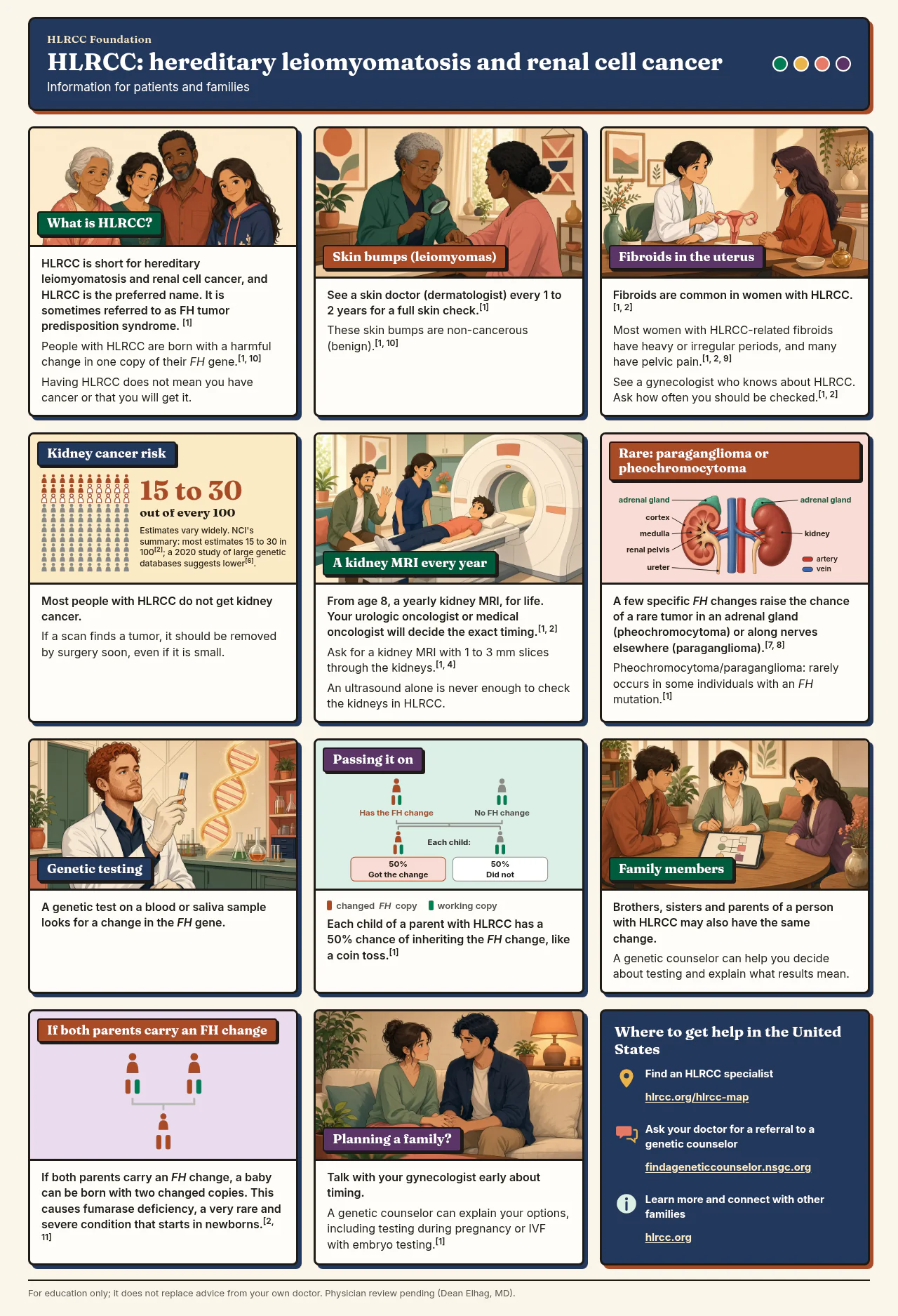
HLRCC at a glance (infographic)
A one-page picture summary of the main points in this Handbook. Print it, or share it with your family and your doctors.
Sources for this infographic
Numbers refer to this list.
Sources (14)
- Kamihara J, Schultz KA, Rana HQ. FH tumor predisposition syndrome. In: Adam MP, Bick S, Mirzaa GM, et al., editors. GeneReviews® [Internet]. Seattle (WA): University of Washington, Seattle; 1993-2026. 2006 Jul 31 [updated 2025 May 8]. PMID: 20301430. ncbi.nlm.nih.gov/books/NBK1252
- PDQ® Cancer Genetics Editorial Board. Hereditary leiomyomatosis and renal cell cancer (PDQ®): health professional version. Bethesda (MD): National Cancer Institute; updated 2024 Nov 6. PMID: 33724749. cancer.gov
- National Comprehensive Cancer Network. NCCN Guidelines for Patients®: Kidney Cancer, 2026 (based on NCCN Guidelines® for Kidney Cancer, Version 1.2026, July 24, 2025). Chapter 7, Hereditary RCC, pp. 56-57 (Guides 9 and 10). nccn.org (PDF)
- Menko FH, Maher ER, Schmidt LS, Middelton LA, Aittomäki K, Tomlinson I, et al. Hereditary leiomyomatosis and renal cell cancer (HLRCC): renal cancer risk, surveillance and treatment. Fam Cancer. 2014;13(4):637-44. PMID: 25012257. doi:10.1007/s10689-014-9735-2
- Muller M, Ferlicot S, Guillaud-Bataille M, Le Teuff G, Genestie C, Deveaux S, et al. Reassessing the clinical spectrum associated with hereditary leiomyomatosis and renal cell carcinoma syndrome in French FH mutation carriers. Clin Genet. 2017;92(6):606-15. PMID: 28300276. doi:10.1111/cge.13014
- Shuch B, Li S, Risch H, Bindra RS, McGillivray PD, Gerstein M. Estimation of the carrier frequency of fumarate hydratase alterations and implications for kidney cancer risk in hereditary leiomyomatosis and renal cancer. Cancer. 2020;126(16):3657-66. PMID: 32413184. doi:10.1002/cncr.32914
- Zavoshi S, Lu E, Boutros PC, Zhang L, Harari A, Hatchell KE, et al. Fumarate hydratase variants and their association with paraganglioma/pheochromocytoma. Urology. 2023;176:106-14. PMID: 36773955. doi:10.1016/j.urology.2022.11.053
- Michaeli O, Kim SY, Mitchell SG, et al. Update on cancer screening in children with syndromes of bone lesions, hereditary leiomyomatosis and renal cell carcinoma syndrome, and other rare syndromes. Clin Cancer Res. 2025;31(3):457-65. PMID: 39601780; PMCID: PMC11790369. doi:10.1158/1078-0432.CCR-24-2171
- Hessi R, Bendayan E, Mija LA, et al. Uterine leiomyomas in HLRCC: a scoping review of presentation, histopathology, treatment patterns, and reproductive implications. Eur J Hum Genet. 2026 Oct 16 [Epub ahead of print]. PMID: 42888221. doi:10.1038/s41431-026-02255-y
- MedlinePlus Genetics. Hereditary leiomyomatosis and renal cell cancer. Bethesda (MD): National Library of Medicine (US) [cited 2026 Oct 30]. medlineplus.gov
- MedlinePlus Genetics. Fumarase deficiency. Bethesda (MD): National Library of Medicine (US) [cited 2026 Oct 30]. medlineplus.gov
- National Cancer Institute. Genetic testing fact sheet [Internet]. Bethesda (MD): NCI; reviewed 2024 Apr 18 [cited 2026 Oct 30]. cancer.gov
- National Society of Genetic Counselors. Find a genetic counselor [Internet; cited 2026 Oct 30]. findageneticcounselor.nsgc.org
- HLRCC Foundation. Find an HLRCC specialist [Internet]. Last reviewed 2026 Oct [cited 2026 Oct 30]. hlrcc.org/hlrcc-map
Printable PDF, 2 pages: the infographic and its 14 sources. Tabloid size (11 x 17 in); it also prints on letter paper.
Open the wide version of the picture (WebP, 1280 x 1875 pixels)
Read the infographic as text
HLRCC Foundation
HLRCC: hereditary leiomyomatosis and renal cell cancer
Information for patients and families
Text version of the HLRCC Foundation comic infographic (v4). It has all the text in the picture, in the same order, and describes each picture and diagram in words. Numbers in brackets refer to the Sources for this infographic, above.
1. What is HLRCC?
Picture: a family of four standing together, a grandmother, a mother, a father and a teenage daughter.
HLRCC is short for hereditary leiomyomatosis and renal cell cancer, and HLRCC is the preferred name. It is sometimes referred to as FH tumor predisposition syndrome.[1]
People with HLRCC are born with a harmful change in one copy of their FH gene.[1, 10]
Having HLRCC does not mean you have cancer or that you will get it.
2. Skin bumps (leiomyomas)
Picture: a dermatologist with a magnifying glass looks at small bumps on a patient’s forearm.
See a skin doctor (dermatologist) every 1 to 2 years for a full skin check.[1]
These skin bumps are non-cancerous (benign).[1, 10]
3. Fibroids in the uterus
Picture: a gynecologist points to a model of a uterus while talking with a woman patient.
Fibroids are common in women with HLRCC.[1, 2]
Most women with HLRCC-related fibroids have heavy or irregular periods, and many have pelvic pain.[1, 2, 9]
See a gynecologist who knows about HLRCC. Ask how often you should be checked.[1, 2]
4. Kidney cancer risk
Picture: 100 small person icons; 15 are filled, 15 more are outlined and 70 are gray. Next to them: 15 to 30 out of every 100. Estimates vary widely. NCI’s summary: most estimates 15 to 30 in 100 [2]; a 2020 study of large genetic databases suggests lower [6].
Most people with HLRCC do not get kidney cancer.
If a scan finds a tumor, it should be removed by surgery soon, even if it is small.
5. A kidney MRI every year
Picture: a child lies on an MRI scanner table while a technologist and a parent reassure him.
From age 8, a yearly kidney MRI, for life. Your urologic oncologist or medical oncologist will decide the exact timing.[1, 2]
Ask for a kidney MRI with 1 to 3 mm slices through the kidneys.[1, 4]
An ultrasound alone is never enough to check the kidneys in HLRCC.
6. Rare: paraganglioma or pheochromocytoma
Picture: drawing of both kidneys with an adrenal gland on top of each, with one kidney cut open to label the cortex, medulla, renal pelvis and ureter; arteries and veins are color-coded.
A few specific FH changes raise the chance of a rare tumor in an adrenal gland (pheochromocytoma) or along nerves elsewhere (paraganglioma).[7, 8]
Pheochromocytoma/paraganglioma: rarely occurs in some individuals with an FH mutation.[1]
7. Genetic testing
Picture: a laboratory scientist holds a sample tube next to a DNA double helix.
A genetic test on a blood or saliva sample looks for a change in the FH gene.
8. Passing it on
Diagram: a parent who has the FH change (one changed copy, one working copy) and a parent with no FH change. Each child has two possible outcomes: a 50% chance of getting the change and a 50% chance of not getting it. Key: changed FH copy, working copy.
Each child of a parent with HLRCC has a 50% chance of inheriting the FH change, like a coin toss.[1]
9. Family members
Picture: a genetic counselor shows a simple family tree on a tablet to an adult brother and sister.
Brothers, sisters and parents of a person with HLRCC may also have the same change.
A genetic counselor can help you decide about testing and explain what results mean.
10. If both parents carry an FH change
Diagram: two parents who each have one changed FH copy, and a child with two changed copies.
If both parents carry an FH change, a baby can be born with two changed copies. This causes fumarase deficiency, a very rare and severe condition that starts in newborns.[2, 11]
11. Planning a family?
Picture: a young couple sits on a sofa, holding hands and talking.
Talk with your gynecologist early about timing.
A genetic counselor can explain your options, including testing during pregnancy or IVF with embryo testing.[1]
Where to get help in the United States
- Find an HLRCC specialist: hlrcc.org/hlrcc-map
- Ask your doctor for a referral to a genetic counselor: findageneticcounselor.nsgc.org
- Learn more and connect with other families: hlrcc.org
For education only; it does not replace advice from your own doctor. Physician review pending (Dean Elhag, MD).
Share with your family
Tear out or copy this page to give to a relative.
Someone in your family has HLRCC. HLRCC is a condition that runs in families. It is caused by a change in a gene called FH. It can cause skin bumps, fibroids in the uterus, and a higher chance of kidney cancer. [1, 2]
Why this matters to you: you may have the same gene change. A simple test can tell you. If you have it, a kidney MRI every year can help find problems early. [1, 2, 3]
Who may be at risk?
- Children of a person with HLRCC each have a 1 in 2 (50%) chance of having the same change. Brothers, sisters and parents may also have it. [1, 2]
- Aunts, uncles, nieces, nephews and grandparents may also be at risk. Their chance depends on how they are related. [1]
- If your parent tested negative for the family change, you did not get it from that parent. [1, 2]
What should I do?
- Ask your relative for a copy of their genetic test report. It names the exact FH change. This makes your test simpler. [1, 2]
- See a genetic counselor or your doctor. Find one at findageneticcounselor.nsgc.org. [19]
- Decide about testing. You can test for the one family change. Testing is your choice. [1, 2]
- Children: From age 8, a yearly kidney MRI, for life. Your urologic oncologist or medical oncologist will decide the exact timing. [1, 2] Talk with a genetic counselor about testing. [5]
If you test positive
You will be offered a kidney MRI every year, skin checks, and gynecology visits if you have a uterus. [1, 2]
If you test negative for the family change
You do not need HLRCC check-ups, and you cannot pass this change to your children. [1, 2]
Learn more: hlrcc.org · Educational, not medical advice
References
The numbers in brackets, like [1], point to these sources.
Sources (21)
- Kamihara J, Schultz KA, Rana HQ. FH tumor predisposition syndrome. 2006 Jul 31 [updated 2025 May 8]. In: Adam MP, Bick S, Mirzaa GM, et al., editors. GeneReviews® [Internet]. Seattle (WA): University of Washington, Seattle; 1993–2026. PMID: 20301430. Available from: https://www.ncbi.nlm.nih.gov/books/NBK1252/
- PDQ Cancer Genetics Editorial Board. Hereditary leiomyomatosis and renal cell cancer (PDQ®): health professional version. Bethesda (MD): National Cancer Institute; updated 2024 Nov 6 [cited 2026 Oct 30]. PMID: 33724749. Available from: https://www.cancer.gov/publications/pdq/information-summaries/genetics/hlrcc-syndrome-hp-pdq
- National Comprehensive Cancer Network. NCCN Guidelines for Patients®: Kidney cancer, 2026 [Internet]. Plymouth Meeting (PA): NCCN; 2026 (based on NCCN Guidelines® for Kidney Cancer, Version 1.2026, 2025 Jul 24) [cited 2026 Oct 30]. Available from: https://www.nccn.org/patients/guidelines/content/PDF/kidney-patient.pdf
- Menko FH, Maher ER, Schmidt LS, Middelton LA, Aittomäki K, Tomlinson I, et al. Hereditary leiomyomatosis and renal cell cancer (HLRCC): renal cancer risk, surveillance and treatment. Fam Cancer. 2014;13(4):637-44. doi:10.1007/s10689-014-9735-2. PMID: 25012257.
- Shuch B, Li S, Risch H, Bindra RS, McGillivray PD, Gerstein M. Estimation of the carrier frequency of fumarate hydratase alterations and implications for kidney cancer risk in hereditary leiomyomatosis and renal cancer. Cancer. 2020;126(16):3657-66. doi:10.1002/cncr.32914. PMID: 32413184.
- Lu E, Hatchell KE, Nielsen SM, Esplin ED, Ouyang K, Nykamp K, et al. Fumarate hydratase variant prevalence and manifestations among individuals receiving germline testing. Cancer. 2022;128(4):675-84. doi:10.1002/cncr.33997. PMID: 34724198.
- Moch H, Amin MB, Berney DM, Compérat EM, Gill AJ, Hartmann A, et al. The 2022 World Health Organization classification of tumours of the urinary system and male genital organs—part A: renal, penile, and testicular tumours. Eur Urol. 2022;82(5):458-68. doi:10.1016/j.eururo.2022.06.016. PMID: 35853783.
- Lenders JW, Duh QY, Eisenhofer G, Gimenez-Roqueplo AP, Grebe SK, Murad MH, et al. Pheochromocytoma and paraganglioma: an Endocrine Society clinical practice guideline. J Clin Endocrinol Metab. 2014;99(6):1915-42. doi:10.1210/jc.2014-1498. PMID: 24893135. Erratum in: J Clin Endocrinol Metab. 2023;108(5):e200.
- National Cancer Institute. Hereditary leiomyomatosis renal cell cancer: study of the genetic cause and the predisposition to renal cancer. ClinicalTrials.gov identifier: NCT00050752 [Internet]. Bethesda (MD): National Library of Medicine; [updated 2026 Oct 26; cited 2026 Oct 30]. Available from: https://clinicaltrials.gov/study/NCT00050752
- National Human Genome Research Institute. Genetic discrimination [Internet]. Bethesda (MD): NHGRI [cited 2026 Oct 30]. Available from: https://www.genome.gov/about-genomics/policy-issues/Genetic-Discrimination
- National Society of Genetic Counselors. Find a genetic counselor [Internet]. Chicago (IL): NSGC [cited 2026 Oct 30]. Available from: https://findageneticcounselor.nsgc.org/
- Michaeli O, Kim SY, Mitchell SG, Jongmans MCJ, Wasserman JD, Perrino MR, et al. Update on cancer screening in children with syndromes of bone lesions, hereditary leiomyomatosis and renal cell carcinoma syndrome, and other rare syndromes. Clin Cancer Res. 2025;31(3):457-65. doi:10.1158/1078-0432.CCR-24-2171. PMID: 39601780.
- ClinicalTrials.gov. Records NCT04981509, NCT03635892, NCT07716735, NCT04623502, NCT01130519, NCT04603365, NCT02495103, NCT03165721, NCT02071862, NCT02576444, NCT00971620, NCT01021059 [Internet]. Bethesda (MD): National Library of Medicine [cited 2026 Oct 30]. Available from: https://clinicaltrials.gov/search?cond=Hereditary%20Leiomyomatosis%20and%20Renal%20Cell%20Cancer
- National Cancer Institute. Hereditary kidney cancer syndromes (PDQ®): patient version [Internet]. Bethesda (MD): NCI [cited 2026 Oct 30]. Available from: https://www.cancer.gov/types/kidney/patient/kidney-genetics-pdq
- Genetic and Rare Diseases Information Center. Hereditary leiomyomatosis and renal cell cancer [Internet]. Bethesda (MD): NIH; last updated 2026 Sep [cited 2026 Oct 30]. Available from: https://rarediseases.info.nih.gov/diseases/10096/hereditary-leiomyomatosis-and-renal-cell-cancer
- Hessi R, Bendayan E, Mija LA, Ouchene L, Udupa M, Lazarowitz R, et al. Uterine leiomyomas in HLRCC: a scoping review of presentation, histopathology, treatment patterns, and reproductive implications. Eur J Hum Genet. 2026 Oct 16. Online ahead of print. doi:10.1038/s41431-026-02255-y. PMID: 42888221.
- MedlinePlus Genetics. What do the results of genetic tests mean? [Internet]. Bethesda (MD): National Library of Medicine [cited 2026 Oct 30]. Available from: https://medlineplus.gov/genetics/understanding/testing/interpretingresults/
- Richards S, Aziz N, Bale S, Bick D, Das S, Gastier-Foster J, et al. Standards and guidelines for the interpretation of sequence variants: a joint consensus recommendation of the American College of Medical Genetics and Genomics and the Association for Molecular Pathology. Genet Med. 2015;17(5):405-24. doi:10.1038/gim.2015.30. PMID: 25741868.
- Deignan JL, Chung WK, Kearney HM, Monaghan KG, Rehder CW, Chao EC; ACMG Laboratory Quality Assurance Committee. Points to consider in the reevaluation and reanalysis of genomic test results: a statement of the American College of Medical Genetics and Genomics (ACMG). Genet Med. 2019;21(6):1267-70. doi:10.1038/s41436-019-0478-1. PMID: 31015575.
- National Cancer Institute. Genetic testing for inherited cancer risk [Internet]. Bethesda (MD): NCI; reviewed 2024 Apr 18 [cited 2026 Oct 30]. Available from: https://www.cancer.gov/about-cancer/causes-prevention/genetics/genetic-testing-fact-sheet
- National Cancer Institute. Pheochromocytoma and paraganglioma treatment (PDQ®): patient version [Internet]. Bethesda (MD): NCI; updated 2025 Apr 10 [cited 2026 Oct 30]. Available from: https://www.cancer.gov/types/pheochromocytoma/patient/pheochromocytoma-treatment-pdq
Take it with you
Print the full guide or share it with your family and care team.
Download the Handbook (PDF)Support the Foundation
Your gift helps fund HLRCC awareness, research and support for patients and families.
HLRCC Foundation · 501(c)(3) nonprofit · EIN 92-3898938
Donate to the HLRCC Foundation