HLRCC Runs in Families: What Your FH Result Means for Your Relatives
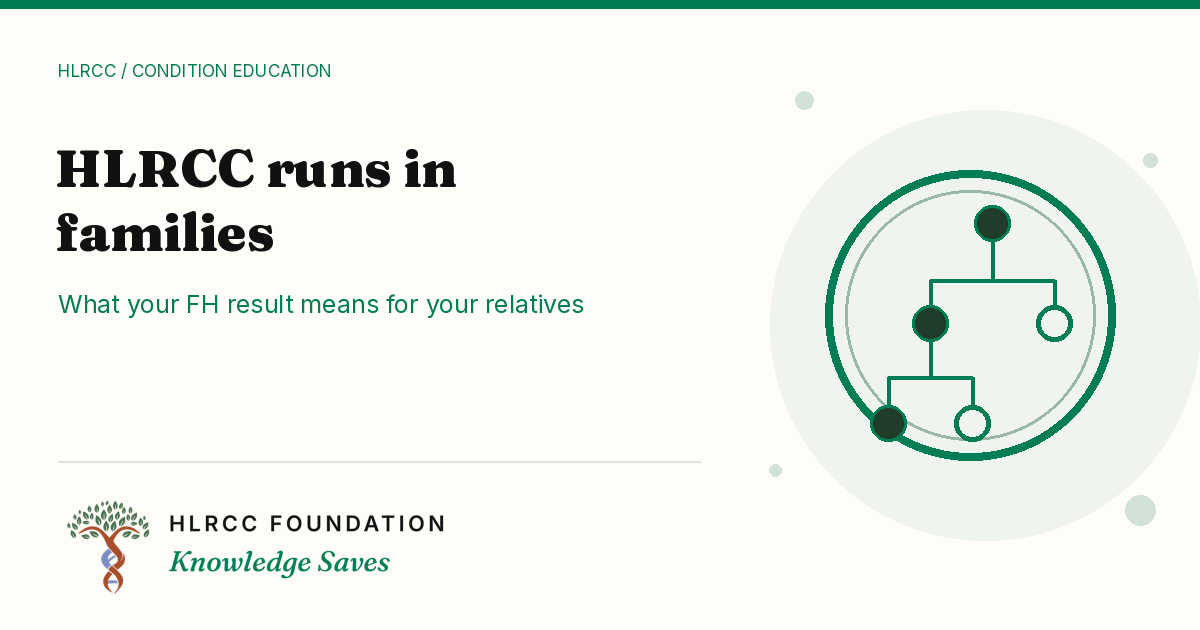
When someone learns they have hereditary leiomyomatosis and renal cell cancer (HLRCC), one of the first questions is often, “What about my family?” It’s a good question, and it’s one of the most hopeful parts of an HLRCC diagnosis. A single genetic test result can help parents, brothers, sisters and children find out where they stand, often before they ever have a symptom.
A quick refresher
HLRCC is caused by a harmful (pathogenic) variant in the FH gene, which makes an enzyme called fumarate hydratase. People with HLRCC can develop benign smooth-muscle growths in the skin and uterus (leiomyomas, including fibroids), and they have a higher risk of a type of kidney cancer. A 2014 expert consensus estimated that kidney cancer risk at approximately 15 in 100 (about 15%), which means most people with HLRCC do not get kidney cancer. Finding the people who carry the variant means they can start kidney screening and catch problems early. Learn more on our What is HLRCC? page.
How HLRCC is passed down
HLRCC is inherited in an autosomal dominant way. In plain terms: each child of a person with HLRCC has a 50% chance of inheriting the FH variant, according to GeneReviews, the expert review hosted on NIH’s NCBI Bookshelf. Sons and daughters are equally likely to inherit it.
Brothers and sisters also have a 50% chance when one of their parents carries the variant. GeneReviews notes that a parent can carry it with or without signs of HLRCC themselves, and that some people are the first in their family to have it (a new, or “de novo,” variant). That’s why a quiet family history doesn’t rule HLRCC out.
What is cascade testing?
The U.S. Centers for Disease Control and Prevention (CDC) describes cascade testing as telling family members about a genetic condition found in the family, then offering them testing. The relatives most likely to share the variant are tested first. From there, testing “cascades” through the family, following the side that carries the variant.
For HLRCC, the first test in a family looks across the FH gene. Once the family’s specific pathogenic (harmful) variant is known, GeneReviews explains that relatives can have predictive testing for that exact variant. A variant of uncertain significance (VUS) does not confirm or rule out HLRCC and should not be used for cascade or predictive testing of relatives. A genetic counselor can help you decide who to contact first and how. Our Genetic Testing page walks through how to get tested.
Why it matters for your relatives
GeneReviews gives two clear reasons to test relatives who are at risk:
- To find those who carry the variant early, so they can benefit from early surveillance and treatment. For people with the variant, GeneReviews recommends annual kidney MRI beginning in childhood, along with skin exams every one to two years and gynecologic care as needed. The exact starting age for MRI is not a single figure in that chapter (the summary says from age eight; the recommended surveillance table and the pediatric guidelines it cites start at age 10), so the care team decides timing.
- To spare those who don’t carry it from screening they don’t need. Family members who have not inherited the variant, and their future children, have risks similar to the general population.
That second point is worth pausing on. A negative result for the family’s known variant is real good news. Those relatives, and their future children, can usually be spared screening they do not need.
Thinking about starting a family
GeneReviews says the best time to understand genetic risk and talk about reproductive options is before pregnancy. It recommends genetic counseling for young adults who have HLRCC or are at risk. Once the family’s variant is known, prenatal testing and preimplantation genetic testing (testing embryos during IVF) are possible. People feel differently about these options, and every choice is a personal one.
GeneReviews also recommends that a reproductive partner be offered testing. That’s because some specific FH variants, when a child inherits one from each parent, can cause a rare and serious childhood condition called fumarate hydratase deficiency. A genetic counselor can explain whether this applies to your family.
Starting the conversation
Telling relatives can feel hard. A few things that help many families:
- Share a copy of your genetic test report, so relatives’ doctors can test for the exact same variant.
- Start with parents, brothers, sisters and adult children.
- Keep it simple: “I found out I have a gene change that causes HLRCC. Doctors know how to watch for it, and you can be tested too.”
- Point them to the HLRCC Handbook and our HLRCC map to find experienced specialists.
You don’t have to do this alone, and neither do they. Sharing what you know often starts with one conversation.
Join us
Connect with families who’ve been through it in our Facebook group, Knowledge Saves, and read the free HLRCC Handbook. If you’d like to help more families get answers, please consider a gift at hlrcc.org/donate-now.
Sources
- Kamihara J, Schultz KA, Rana HQ. FH Tumor Predisposition Syndrome. In: Adam MP, et al., eds. GeneReviews®. University of Washington, Seattle; 2006, comprehensive update May 8, 2025. https://www.ncbi.nlm.nih.gov/books/NBK1252/
- Centers for Disease Control and Prevention. About Cascade Testing. https://www.cdc.gov/cascade-testing/about/index.html
- Menko FH, Maher ER, Schmidt LS, et al. Hereditary leiomyomatosis and renal cell cancer (HLRCC): renal cancer risk, surveillance and treatment. Fam Cancer. 2014;13(4):637–644. Free full text